
Gingivitis
Gingivitis, the earliest stage of gum disease, leads to red, swollen gums that may bleed. It is reversible with proper care.
Read more


Root canal treatment, also referred to as endodontic therapy, is an effective and safe treatment for teeth whose pulp has become inflamed or infected. It can also be required in other situations to help save and restore a tooth.
Root canal treatment is routinely performed successfully by dentists across Canada. A dentist who has taken advanced training in endodontic therapy is called an endodontist and may be recommended by your dentist for more complex cases. Root canal treatment remains, for many patients, the only viable option to retain a tooth that has suffered severe damage or has become infected.
Root canal treatment is the process of removing infected or injured tissue (pulp) from inside the crown and roots of a tooth. Once cleaned, the canal is disinfected, shaped, filled and sealed with natural rubber-like material called gutta percha. The opening of the tooth is then sealed with either a temporary or permanent filling to prevent future infection. Considerable advancements in diagnosis, radiographic imaging, equipment and techniques now permit dentists and endodontists to complete root canal treatment, even for teeth with very complex anatomies, to the highest level of precision.
The Canadian Dental Association (CDA) and the Canadian Academy of Endodontics (CAE) caution that misinformation about root canal treatment is circulating in the public domain. Patients are advised to discuss any questions or concerns about root canal treatment with their dentist and endodontist to ensure that unnecessary anxiety or fear of developing other health problems does not result in treatment delays which could further compromise the integrity of the tooth.
Taking proper care of your teeth and gums is a lifelong commitment. The best way to prevent the need for root canal treatment is to follow a good oral hygiene routine by brushing twice a day, flossing once a day, and to visit your dentist regularly.
Please visit these trustworthy sources of information which address common misconceptions about root canal treatment.
The Canadian Dental Association (CDA) and the Canadian Academy of Endodontics (CAE) are aware that misinformation about root canal treatment is circulating in the public domain. False claims about root canal treatment is harmful because it creates undue fear, or confusion among patients and their families which can lead to delays in seeking treatment and result in the loss of otherwise treatable teeth. The spread of inaccurate information about root canal treatment is not beneficial to patients in terms of their comfort, safety, or long-term health.
Since patient safety, quality oral health care, and knowledge about oral health and related procedures are top priorities for CDA, it has worked with the CAE to provide the most current and factual information about root canal treatment and its safety. The CDA is committed to share important information about oral health and will continue to monitor the situation.
When the nerve of your tooth becomes infected, a successful root canal treatment lets you keep the tooth rather than having to pull it out. Keeping your tooth helps to prevent your other teeth from drifting out of line and causing jaw problems. Saving a natural tooth avoids having to replace it with an artificial tooth.
What is root canal treatment?
Who does this procedure?
How is a root canal treatment done?
How is a tooth restored after root canal treatment?
What else should I know?
What is root canal retreatment?
What is root canal surgery?
What is root canal treatment?
Root canal treatment, also known as endodontic treatment, is the process of removing infected, injured or dead pulp from your tooth. The space inside the hard layers of each tooth is called the root canal system. This system is filled with soft dental pulp made up of nerves and blood vessels that help your tooth grow and develop.
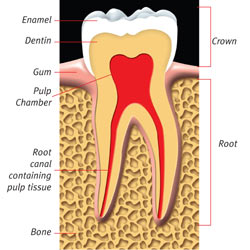 |
A healthy tooth. |
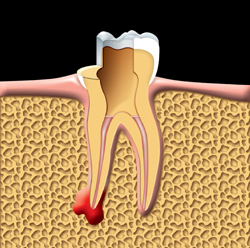
When bacteria (germs) enter your tooth through deep cavities, cracks or flawed fillings, your tooth can become abscessed. An abscessed tooth is a tooth with an infection in the pulp. If pulp becomes infected, it needs to be removed. An abscessed tooth may cause pain and/or swelling. Your dentist may notice the infection from a dental x-ray or from other changes with the tooth. If left untreated, an abscessed tooth can cause serious oral health problems.
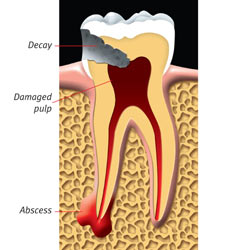 |
An abscessed tooth. |
Who does this procedure?
Your dentist may do root canal treatment or refer you to an endodontist. An endodontist is a dentist who has completed a university post-graduate specialty program in endodontics. Endodontics is a specialty of dentistry concerned with the treatment of the dental pulp or nerve of the tooth.
If your child's primary (baby) tooth is damaged, your dentist may refer you to a pediatric dentist for this procedure. A pediatric dentist has at least 2 years of extra university training in treating children.
How is a root canal treatment done?
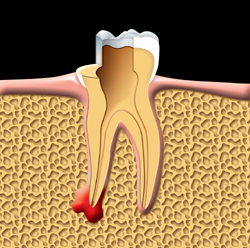 |
The damaged pulp is removed. |
 |
The root canals are filled and sealed. |
How is a tooth restored after root canal treatment
After a root canal treatment, your tooth has to be restored (fixed) to look, feel and work as much like a natural tooth as possible. If an endodontist performed your root canal treatment, he or she will fill the opening of the tooth with a temporary filling and send you back to your dentist or prosthodontist for tooth restoration.
A prosthodontist is a dental specialist who restores and replaces teeth using crowns, bridges, dentures and implants. Your dentist or specialist may use a permanent filling or a crown to restore your tooth. The choice of restoration will depend on the strength of the part of the tooth that's left. A back tooth will likely need a crown because chewing puts a great deal of force on back teeth. If there is not enough of the tooth left, posts may be used to help support the crown.
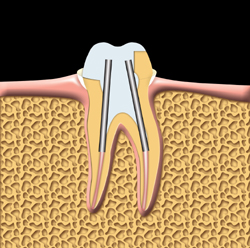 |
The tooth is prepared for a crown. |
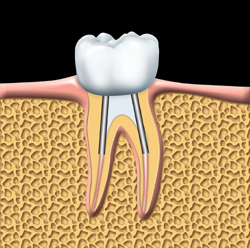 |
The crown is cemented into place. |
What else should I know?
Root canal treatment may be done in 1 or 2 appointments. After root canal treatment, your tooth may be tender for the first week or two. Bad pain or swelling are NOT common. If this happens, call your dentist or endodontist.
You can still get a cavity or gum disease after a root canal treatment. Root canal treatment does not protect your tooth from other types of damage. With proper care and regular dental visits, the tooth could last as long as your other teeth. Most of the time, a tooth that has had a root canal treatment can be saved. However, there are cases where everything possible has been done to save a tooth and still the tooth must be extracted (pulled).
What is root canal retreatment
Most root canal treatments are successful. But in some rare cases, a second root canal treatment is needed. This is called retreatment. When retreating a tooth, the root canal filling material is taken out, and the canal is recleaned, reshaped and refilled.
What is root canal surgery
Sometimes root canal surgery is needed when a regular root canal treatment cannot be done or when it has not worked. Surgery is done to:

Explore more essential topics to deepen your understanding of oral health and take proactive steps toward maintaining a healthy smile.
Find answers to some of the most common questions about oral health, dental treatments, and more.
How often you go for dental exams depends on your oral health needs. The goal is to catch small problems early. For many people, this means a dental exam every six months. Your dentist may suggest that you visit more or less often depending on how well you care for your teeth and gums, problems you have that need to be checked or treated, how fast tartar builds up on your teeth, and so on.
Ask yourself the following questions:
The answers to these questions are all factors that affect your oral health. They will help you and your dentist decide how often you need to visit for dental exams. It's worth noting that you should not determine your need for dental care on what your dental plan covers.
Do I need x-rays at each visit?
How often you need to have x-rays also depends on your oral health. A healthy adult who has not had cavities or other problems for a couple of years probably won't need x-rays at every appointment. If your dental situation is less stable and your dentist is monitoring your progress, you may require more frequent x-rays.
If you are not sure why a particular x-ray is being taken, ask your dentist. Remember that dental x-rays deliver very little radiation; they are a vital tool for your dentist to ensure that small problems don't develop into bigger ones.
Related Resources
The first step in choosing a new dentist is to list your needs, which might include:
Yellow Pages advertising may also prove helpful. It will list each dentist's location, and may include other details that will help you in your search.
Once you have narrowed your list to two or three names, call the dentists to see if they are accepting new patients. This initial call may also give you some sense of the office environment, but there's nothing like the first visit to help you decide if it's a good match for you.
How can I get my records transferred?
Original dental records belong to the dentist who provided the treatment, and not the patient, because dentists have to keep all of their records for a period of time, as set out by their provincial dental regulatory body. Once you have selected a new dentist, you can request that a copy of your records be transferred from your former dentist.
You may be required to sign a release form from your former dental office and you may also be charged an administrative fee for having your records copied and sent to another dental office. If you have questions about the records transfer process in your province, ask your dentist or contact the provincial dental regulatory body.
Other Resources
Provincial Regulatory Authorities and Provincial Associations
Your health is very important to your dentist. One of the ways that your dentist helps you stay healthy is by preventing the spread of germs. One of the best ways to do this is to use barrier protection such as gloves and masks.
Your dentist and other dental team members also wash their hands regularly. In addition, they sterilize equipment used in the dental office and clean the furniture and fixtures in the examining rooms. This system is referred to as "standard precautions." It means that every patient is treated in the same way because patients don't always know if they're sick. It's always better to be safe than sorry.
If you would like to know how this system is carried out in your dentist's office, ask to be shown how it's done. Dentists welcome the opportunity to ease their patients' concerns, rather than have them leave the office with unanswered questions. Once you see the work that goes into making the dental office a clean and safe environment, you will feel reassured.
It is worth noting that even though standard precautions are used, it is still important to tell your dentist of changes in your health. This will help your dentist suggest the right choices of treatment for you.
It's important to get an early start on dental care, so that your child will learn that visiting the dentist is a regular part of health care. The first step is to choose a dentist for your child.
It may be your own dentist or one who specializes in treating children (called a pediatric dentist). Once you have selected a dentist, call the office to find out at what age he or she prefers to see child patients for the first time. CDA encourages the assessment of infants, by a dentist, within 6 months of the eruption of the first tooth or by one year of age.
It's important to make the first visit a positive experience for your child - one reason why it's best to visit before a problem develops. If you think there is a problem, however, take your child to the dentist right away, no matter what age.
If you are a nervous dental patient, ask your spouse or another family member to take the child for the appointment. If your child senses that you are nervous, he or she may feel nervous too. When you talk to your child about going to the dentist, explain what will happen without adding things like "it won't hurt" or "don't be scared."
Be sure to get an early start on regular dental care at home. Start cleaning your child's mouth with a soft damp cloth before teeth come in and continue with a soft toothbrush once he or she has a first tooth. Limit the number of sugary treats you give your child, and focus on healthy food choices from the very beginning.
Other Resources
Dental plans, offered by many employers, are a means to help you pay for your dental treatment. Most Canadians enjoy dental plans and the insurance companies that provide them are actually benefit carriers. Carriers reimburse patients based on the level of coverage decided by the patient's employer.
When you visit the dentist, it's the dentist's role to make a treatment plan based on your oral health needs. Your needs may be different from what is covered by your dental plan. It is your right to decide whether or not to go ahead with any treatment.
You should not decide based on what your plan covers. If you agree to have the treatment, it's your responsibility to pay for it. It is the responsibility of the benefits carrier's to reimburse you for the amount covered by your dental plan.
Many dentists are willing to contact a patient's benefits carrier, on a patient's behalf, to find out if a treatment is covered. The patient has to pay the portion that's not covered and the dentist may offer a payment plan to help.
I don't have dental insurance and can't afford to go to the dentist. What can I do and why does dentistry cost so much anyway?
If you do not have a dental plan and cannot afford to pay your entire bill at once, ask your dentist about a payment plan. If you cannot afford care, even with a payment plan, contact the nearest:
Dental services may seem expensive. In Canada, we don't have to pay directly when we visit a doctor or hospital, so we may not realize the high cost of providing health services. Overhead costs are high for dentists. They have staff, equipment and other operating costs.
The good news is that you can avoid costly dental treatment by brushing, flossing and visiting your dentist regularly for a dental exams. Regular dental exams cost money, but they are less expensive than fixing serious dental problems that stem from neglect.
Other Resources
Dentists have been doing what's called "non-vital" bleaching for many years. Non-vital bleaching is done on a damaged, darkened tooth that has had root canal treatment. "Vital" bleaching is done on healthy teeth and has become more popular in recent years.
Vital bleaching, also called whitening, may be carried out in the dental office or the dentist may instruct the patient on how to do the bleaching at home. There is also a wide variety of products for sale in stores. Not all products are the same and not all give you the same results.
Different products, including those used by dentists, may also have different risks and side effects.
Here is an overview:
Whitening toothpastes with abrasive ingredients are really not bleaching products at all, but work on surface stain only. These products are sold in many stores.
Some whitening toothpastes do contain a chemical ingredient (or "bleach") that causes a chemical reaction to lighten teeth. Generally, they have the lowest amount of "bleach." They may not whiten as well as stronger products, but they have less chance of side effects. These pastes are brushed onto teeth and rinsed off, like regular toothpaste.
Bleaching kits sold in stores stay on your teeth longer than toothpaste and contain stronger "bleach". These store-bought products do not come with the added safety of having your dentist monitor any side effects. They also come with a one-size-fits-all tray that holds the "bleach" and is more likely to leak the chemical into your mouth.
Dentists may use products with stronger "bleach", but they give patients careful instructions to follow. They are also trained to spot and treat the side effects that patients sometimes report during bleaching. In addition, if a tray is needed to apply the "bleach", dentists supply custom-made trays. Because products used by dentists are strong, they tend to produce the best results.
Patients should be aware that the long-term use of whitening or bleaching products may cause tooth sensitivity or tooth abrasion. Please consult with your dentist before using a whitening or bleaching product.
Ask questions. It sounds simple enough, but sometimes we feel embarrassed to ask simple questions. There is no need to feel that way.
You will feel much better, and be able to make a better decision, if you understand the dental procedure that is recommended to you. If you don't say anything, your dentist may think that you already understand.
Here are some tips when asking questions. Ask:
The final decision about how and when to proceed with any treatment is yours. To help you understand what is involved in the treatment, your dentist may give you some printed material to read.
If you have already left the dental office without asking questions, call back later. Be careful about getting information from unknown sources, including sources on the Internet. Some of this information may not be reliable.
After all your questions have been answered, if you are still uncertain, you may wish to get a second opinion from another dentist. Often, a second opinion will give you confidence that your dentist has planned the right treatment for you.
CDA is not responsible for handling complaints since we have no mandate to regulate dentists. Formal complaints concerning the professional services received in a dental office are handled by your provincial regulatory body.
A directory of provincial dental regulatory authorities is available on CDA's website at: Regulatory Authorities & Provincial Associations.
Explore frequently asked questions by topic:


